The leaders of Australia, India, Japan and the United States have reaffirmed their commitment to a free and open Indo-Pacific, announcing expanded cooperation on maritime surveillance, cybersecurity, artificial intelligence, critical infrastructure and regional economic security.
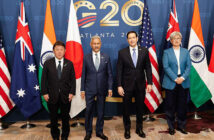
Meeting in Manila, Philippines, on 17 November 2026, Australian Prime Minister Anthony Albanese joined US President Donald Trump, Indian Prime Minister Narendra Modi and Japanese Prime Minister Sanae Takaichi for the latest Quadrilateral Security Dialogue (Quad) Leaders’ Summit.
The meeting, held alongside ASEAN-related summits, marked the first Quad leaders’ gathering of President Trump’s current administration and came amid heightened regional tensions, concerns over economic coercion and growing competition over critical technologies and supply chains.
In their joint statement, the four leaders reaffirmed their opposition to unilateral attempts to change the regional status quo through force or coercion, while expressing concern over arbitrary export restrictions and other forms of economic pressure.
The leaders described the Quad as a partnership focused on practical cooperation, with commitments extending across maritime security, economic resilience, emerging technologies and humanitarian assistance.
The most significant security announcement was the expansion of the Indo-Pacific Maritime Surveillance Collaboration, designed to strengthen information sharing and maritime domain awareness across the region.
Under the initiative, P-8 and P-3C maritime patrol aircraft from the four countries are scheduled to participate in a maritime exercise in 2027, marking the first such activity involving the aircraft in a Quad context.
The initiative is intended to improve cooperation in monitoring maritime activity, supporting regional security and strengthening the ability of participating countries to identify potential threats across important shipping routes.
The leaders also committed to maintaining open, safe and resilient maritime transit corridors, reinforcing the importance of freedom of navigation and overflight.
Japan’s Ministry of Foreign Affairs confirmed that discussions included developments in the East China Sea and South China Sea, as well as the situation in the Middle East, including Iran and the security of international maritime routes.
The summit also produced an announcement on enhanced Quad cybersecurity cooperation, acknowledging the increasing frequency and scale of cyber incidents affecting the Indo-Pacific.
The four countries agreed to strengthen collaboration towards an open and secure cyberspace, building on existing engagement between senior cybersecurity officials.
While the joint statement did not specify new funding or detailed operational arrangements for the cybersecurity initiative, the commitment signals continued recognition of cyber resilience as a central component of regional security.
Cooperation on artificial intelligence was another priority, with the leaders endorsing the Super Intelligence Accelerator announced by Quad foreign ministers during their meeting in Atlanta on 31 October.
The initiative is intended to coordinate funding, technical assistance and the deployment of trusted AI technologies across the Indo-Pacific. The joint statement clarified that the term “Super Intelligence” refers to artificial intelligence in Australia, India and Japan.
At their earlier ministerial meeting, the four countries outlined an intention to provide more than US$85 million in technical and financial assistance to expand access to trusted AI technologies.
The initiative reflects a broader Quad effort to strengthen technological capability and reduce dependencies in strategically important sectors, including advanced communications, semiconductors and AI infrastructure.
Critical infrastructure resilience also featured prominently in Manila.
The leaders welcomed further progress under the Quad Partnership for Cable Connectivity and Resilience, which supports secure and trusted communications infrastructure across the Indo-Pacific.
Australia announced an expansion of its contribution to include electricity cables, broadening the partnership’s focus from telecommunications connectivity to regional energy security.
The leaders also welcomed upcoming undersea cable projects in the Indian Ocean intended to improve regional connectivity and infrastructure resilience.
Economic security and supply chain diversification remained central to the discussions, particularly in relation to critical minerals and strategic technologies.
The leaders reaffirmed their commitment to securing critical supply chains and addressing economic coercion, including arbitrary export restrictions.
These commitments build on the Quad Critical Minerals Initiative Framework announced in May 2026 and subsequent ministerial discussions concerning recycling, refining and reducing reliance on individual suppliers.
At the October foreign ministers’ meeting, the United States announced a US$10 million commitment to support infrastructure and facilities in India and ASEAN countries recovering critical minerals from electronic waste and other recyclable materials.
The Manila summit also confirmed that the inaugural Quad Business Leaders’ Forum will take place in early 2027, bringing together industry executives, government officials and policy specialists to encourage commercial partnerships and investment.
The forum is expected to support cooperation in sectors considered important to the Indo-Pacific’s economic resilience and technological development.
Beyond defence and economic security, the four leaders reaffirmed their commitment to humanitarian assistance and disaster response, recognising the importance of regional cooperation during natural disasters and emergencies.
Existing Quad initiatives include the Indo-Pacific Logistics Network, designed to improve coordination and logistics capabilities during humanitarian operations, and maritime training programs intended to strengthen regional capacity.
The leaders also condemned terrorism and violent extremism, including cross-border terrorism, and committed to strengthening existing counterterrorism cooperation.
A central diplomatic message from the summit was continued support for ASEAN centrality and unity, with the four countries emphasising that their cooperation would complement broader regional institutions rather than replace them.
Japan’s Prime Minister Takaichi said the Quad should strengthen the resilience of regional countries and support their ability to make independent decisions, particularly in maritime security, economic security, energy and emerging technologies.
The meeting also marked a decade since former Japanese Prime Minister Shinzo Abe articulated the vision of a Free and Open Indo-Pacific in 2016, a concept that has subsequently become central to Quad cooperation.
For Australia, the outcomes reinforce the Quad’s growing role as a platform for practical security and economic cooperation across the Indo-Pacific.
The planned maritime patrol aircraft exercise, enhanced cybersecurity engagement and expanded infrastructure initiatives provide opportunities for closer operational coordination with regional partners.
However, several commitments remain at the planning or implementation stage, with further detail required on funding, operational arrangements and delivery timelines.
The Manila summit nevertheless demonstrated continued political support for the Quad as a strategic partnership, with the four countries seeking to translate shared security interests into practical regional initiatives.
The next significant milestones include the maritime surveillance exercise, the inaugural business forum and further implementation of cybersecurity, AI and infrastructure cooperation during 2027.