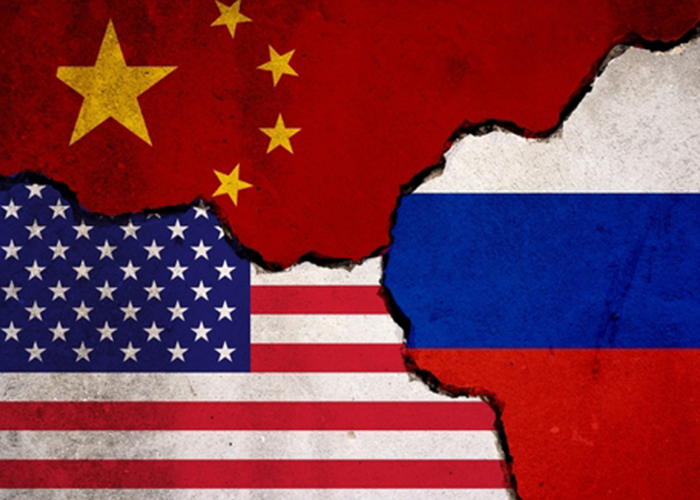
The leaders of the United States, China and Russia have issued a joint declaration committing to nuclear risk reduction, United Nations reform and greater energy security following a trilateral meeting in Shenzhen, China, on 19 November 2026.
US President Donald Trump, Chinese President Xi Jinping and Russian President Vladimir Putin met on the sidelines of the Asia-Pacific Economic Cooperation (APEC) summit, marking a diplomatic engagement between three nuclear powers.
The meeting produced a four-point document titled the China-Russia-US Heads of State Declaration toward Peace, outlining commitments to international security, energy cooperation, reform of global institutions and nuclear non-proliferation.
However, the declaration made no reference to Russia’s continuing war in Ukraine, despite expectations that the conflict would feature in discussions.
The absence of any agreement concerning Ukraine, together with limited detail on how the broader commitments would be implemented, raises questions about whether the summit will produce substantive changes to the international security environment.
The declaration’s most significant security commitment was a renewed undertaking to reduce nuclear risks and prevent the proliferation of nuclear weapons.
The three leaders reaffirmed that a nuclear war “cannot be won and must never be fought”, committing their governments to further dialogue on nuclear security.
The agreement comes at a critical point for international arms control following the expiry of the New START nuclear arms reduction treaty between the United States and Russia in February 2026.
The treaty had established limits on deployed strategic nuclear weapons and provided mechanisms for monitoring the two countries’ nuclear arsenals.
Its expiry removed the last remaining bilateral strategic nuclear arms limitation treaty between Washington and Moscow, increasing uncertainty about the future of nuclear weapons controls.
President Trump has previously advocated a new nuclear arms control framework involving China, although Beijing has historically resisted participation in agreements that would place its smaller nuclear arsenal under restrictions comparable to those imposed on the United States and Russia.
The Shenzhen declaration does not establish binding weapons limits, verification arrangements or a timetable for negotiations.
Nevertheless, the agreement to pursue dialogue represents a potential starting point for renewed engagement on strategic stability between the three countries.
The leaders also committed to reforming the United Nations to improve its capacity to respond to global security challenges.
As permanent members of the UN Security Council, the United States, China and Russia hold veto powers that can prevent the adoption of binding resolutions, including those addressing international conflicts.
The declaration states that the three countries will work towards reforming the organisation to strengthen its ability to maintain international peace and security.
However, it does not identify specific institutional reforms or address the longstanding disagreements over the use of veto powers.
Another significant element of the declaration concerns international energy security.
The three countries announced plans to increase the production and supply of refined petroleum products, while reaffirming the importance of maintaining stable global energy flows.
The commitment comes amid continuing disruption to international energy markets associated with conflicts in the Middle East and the war in Ukraine.
Energy security has become an increasingly important strategic consideration for Indo-Pacific countries, particularly those dependent on imported petroleum products and international shipping routes.
However, the declaration provides no production targets, commercial arrangements or implementation timetable.
A potentially contentious component of the agreement concerns the International Criminal Court (ICC) and the legal protections afforded to state officials.
The three leaders emphasised the importance of state consent and official immunities, stating that the ICC and similar institutions must not abuse their jurisdiction.
The position carries particular significance for President Putin, who remains subject to an ICC arrest warrant issued in March 2023 over allegations concerning the unlawful deportation and transfer of Ukrainian children during Russia’s invasion.
Russia rejects the court’s jurisdiction and allegations, while the United States and China are not parties to the Rome Statute establishing the ICC.
The declaration does not alter the court’s legal authority or cancel existing arrest warrants, but its language signals a shared political position on the limits of international judicial intervention.
The meeting also attracted attention over its failure to address the war in Ukraine in the final declaration.
Ahead of the talks, President Trump indicated that Ukraine would be discussed, while Putin referred to the conflict among the regional security issues requiring international cooperation.
Despite these statements, the final document contained no commitment to a ceasefire, negotiations or any specific measures intended to end the conflict.
Australian Prime Minister Anthony Albanese, attending the APEC summit, directly challenged Putin over the invasion during his address to regional leaders.
“I say very directly to President Putin: end your war, end it now,” Albanese said.
The Prime Minister also warned that international conflicts were contributing to inflation, disrupting global supply chains and undermining the economic stability of countries across the Indo-Pacific.
Albanese welcomed the opportunity for dialogue between the three leaders while expressing hope that the meeting would produce outcomes in the broader international interest.
The trilateral gathering has also generated concerns about the potential for major powers to negotiate international security arrangements without the direct participation of countries most affected by those decisions.
Ukrainian President Volodymyr Zelenskyy previously warned against the possibility of the meeting becoming another Yalta-style conference, referencing the 1945 negotiations between Allied leaders that helped shape the post-war European order.
Although the Shenzhen declaration contains no territorial agreements or proposals for resolving the Ukraine conflict, the meeting highlights the continuing influence of major-power diplomacy on international security arrangements.
For Australia and other Indo-Pacific nations, the outcomes carry implications extending beyond relations between Washington, Beijing and Moscow.
The three countries possess significant military capabilities, maintain extensive interests across the Indo-Pacific and exercise considerable influence over international security institutions.
Their commitment to nuclear risk reduction is particularly relevant as regional governments respond to military modernisation, expanding missile capabilities and increasing strategic competition.
The declaration also comes amid continuing tensions involving Taiwan, the South China Sea and the Korean Peninsula, although none of these issues was specifically addressed in the four-point agreement.
The absence of detailed commitments on regional security leaves uncertainty about whether the diplomatic engagement will influence military activities or strategic competition across the Indo-Pacific.
For Australia, the meeting also presents questions about the future role of multilateral institutions and the extent to which major powers may seek to shape international security arrangements through smaller diplomatic groupings.
The summit followed the Quad Leaders’ Meeting in Manila earlier in the week, where Australia, India, Japan and the United States reaffirmed cooperation on maritime security, cybersecurity and regional resilience.
While the Quad emphasises cooperation among Indo-Pacific partners, the Shenzhen summit brought together three major powers whose strategic interests frequently diverge.
The declaration therefore represents a diplomatic development rather than a comprehensive security agreement.
Its commitments to nuclear dialogue, UN reform and energy cooperation provide potential areas for future engagement, but the absence of implementation mechanisms and agreements on active conflicts limits its immediate operational significance.
The principal test will be whether the three governments translate the declaration into sustained negotiations, measurable nuclear risk reduction initiatives and practical cooperation on international security.
For the Indo-Pacific, the summit demonstrates that dialogue between competing major powers remains possible, even as military tensions, geopolitical rivalries and unresolved conflicts continue to shape the regional security environment.