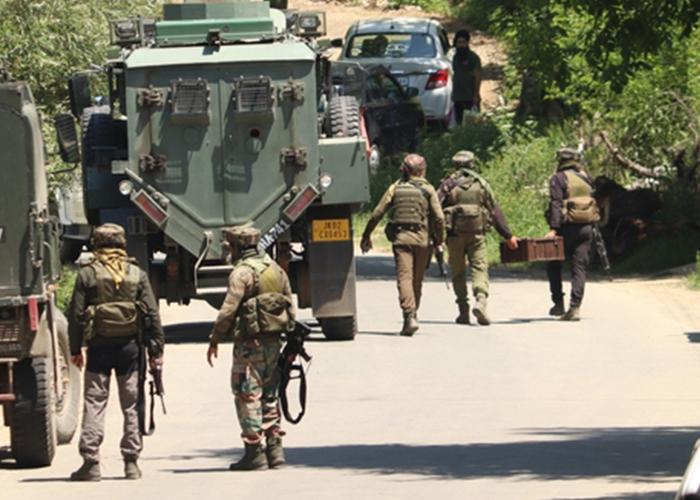
A series of militant attacks targeting Indian security personnel in Jammu and Kashmir has renewed concerns about regional stability, despite new conflict data showing a significant reduction in militant activity throughout 2026.
Analysis released on 19 November 2026 by the Armed Conflict Location & Event Data organisation (ACLED) indicates that militant activity between January and mid-November was nearly half the level recorded during the whole of 2025. However, the organisation warns that the continued targeting of security personnel and the potential emergence of new militant networks demonstrate that the region remains vulnerable to further violence.
The latest escalation followed an attack on a Central Reserve Police Force (CRPF) checkpoint in Kulgam district, South Kashmir, on 11 November, which injured three security personnel.
Indian security forces subsequently launched a cordon-and-search operation between 16 and 18 November, killing two suspected militants, including an alleged commander of Lashkar-e-Taiba (LeT), a Pakistan-based militant organisation.
Indian authorities identified the commander as one of the last surviving active local militants in the area, reflecting the impact of sustained counterinsurgency operations.
However, responsibility for the checkpoint attack remains disputed.
Indian security forces attributed the incident to LeT, while a previously little-known organisation identifying itself as Pasdaran-e-Hurriyat Kashmir also claimed responsibility. Indian security agencies suspect the group may be operating as a front for LeT, although that connection has not been independently established.
In a separate incident on 11 November, two Special Police Officers disappeared in Jammu’s Kishtwar district. Their bodies were discovered the following day with multiple gunshot wounds.
The killings have raised concerns about the vulnerability of locally recruited security personnel, particularly those operating in areas where militant networks retain some capacity to conduct targeted attacks.
According to ACLED South Asia analyst Pooja George, the incidents demonstrate that declining militant activity does not necessarily indicate that the underlying security threat has been eliminated.
“The latest escalation shows the security risks in the region haven’t gone away, even as militancy has declined overall,” George said.
ACLED’s analysis indicates that armed confrontations between militants and Indian security forces account for more than 80 per cent of recorded militant activity in Jammu and Kashmir during 2026.
The figures suggest that militant operations are increasingly concentrated on engagements with security forces rather than a broader campaign of frequent attacks.
Nevertheless, ACLED reports that Indian security forces are now in a stronger operational position, with their losses during armed clashes falling sharply compared with 2025.
This changing security environment could encourage surviving militant networks to adapt their tactics, potentially shifting towards more vulnerable targets.
George identified Special Police Officers, who are local residents temporarily appointed to assist police, as a particular area of concern.
The organisation’s assessment suggests that attacks against these personnel could provide militants with opportunities to maintain pressure on authorities while avoiding direct confrontation with better-equipped security units.
The latest incidents also highlight the potential for smaller militant networks to remain operational despite sustained counterinsurgency activity.
ACLED warned that local groups, potentially supported by more established organisations operating across international borders, could continue conducting targeted attacks even as overall militant numbers decline.
Indian officials have reported that local militant recruitment has fallen to record lows, although ACLED cautions that these gains may prove temporary without progress towards addressing longstanding political grievances.
The security response following the Kulgam attack has also attracted scrutiny.
According to ACLED, more than 500 people were detained during subsequent security operations, while authorities conducted searches of residential areas and subjected civilians to security checks.
The organisation noted that these measures reflected established patterns of counterinsurgency operations in the territory.
While such operations are intended to identify militants and disrupt support networks, ACLED argues that extensive security restrictions may also contribute to community grievances and undermine longer-term reconciliation efforts.
The latest assessment follows broader research published by ACLED examining changes in militant activity across Jammu and Kashmir.
That research identified a geographical shift in militant operations from the Kashmir Valley towards the Jammu division, where mountainous and forested terrain can complicate security operations.
ACLED reported that more than 60 per cent of violent militant activity in the territory occurred in Jammu during 2025, compared with approximately five per cent in 2018.
The organisation also identified growing risks associated with attacks against civilians, particularly incidents targeting communities on the basis of religious or regional identity.
These developments have wider implications for relations between India and Pakistan, which remain divided over Kashmir.
The region was central to the military confrontation between the two countries in May 2025, following a deadly attack against tourists in Pahalgam.
That incident demonstrated how a single high-profile militant attack could trigger a broader security crisis between the two nuclear-armed neighbours.
Although the latest November incidents have not resulted in comparable escalation, ACLED’s findings suggest that the potential for renewed tensions remains.
The organisation’s assessment distinguishes between a reduction in the frequency of militant violence and the more complex challenge of establishing lasting political stability.
The decline in militant activity indicates that Indian counterinsurgency operations have achieved significant security gains. However, the persistence of targeted attacks, the possible emergence of new militant organisations and unresolved political grievances present continuing challenges.
For regional security authorities, the findings highlight the importance of maintaining intelligence capabilities, protecting vulnerable security personnel and monitoring changes in militant tactics.
They also underscore the potential limitations of measuring stability solely through the number of recorded security incidents.
ACLED’s analysis suggests that periodic outbreaks of violence remain likely, even if the overall trajectory of militant activity continues to decline.
The latest attacks therefore present a continuing challenge for Indian authorities seeking to consolidate security gains and demonstrate that Jammu and Kashmir has entered a period of sustained stability.