The leaders of Australia, India, Japan and the United States are expected to meet in Manila this week for the first Quad leaders’ summit in more than two years, amid growing strategic competition, maritime security challenges and concerns over the resilience of critical supply chains across the Indo-Pacific.
The anticipated meeting on Tuesday, 17 November, would bring together Australian Prime Minister Anthony Albanese, Indian Prime Minister Narendra Modi, Japanese Prime Minister Sanae Takaichi and US President Donald Trump on the sidelines of the ASEAN Summit in the Philippines.
US Secretary of State Marco Rubio indicated following the Quad Foreign Ministers’ Meeting in Atlanta on 31 October that a leaders’ meeting would take place in Manila.
However, as of 16 November, a final programme and formal confirmation of the leaders’ meeting had not been independently verified from all four governments.
The meeting would be the first at leaders’ level since September 2024, when the four countries gathered in Wilmington, Delaware, under then US President Joe Biden.
The Quad, comprising Australia, India, Japan and the United States, has developed into an important diplomatic and practical cooperation mechanism focused on maintaining a free, open and stable Indo-Pacific.
Although frequently described as the Quadrilateral Security Dialogue, the Australian Government formally refers to the partnership as the Quad.
Unlike a formal military alliance, the grouping operates through diplomatic engagement, ministerial consultations and cooperation across maritime security, economic resilience, critical technologies and humanitarian assistance.
Its activities have expanded significantly in recent years, reflecting growing concerns about regional maritime tensions, economic coercion and the vulnerability of strategic infrastructure.
The latest meeting follows three Quad Foreign Ministers’ meetings during 2026, held in New Delhi in May, Manila in July and Atlanta in October.
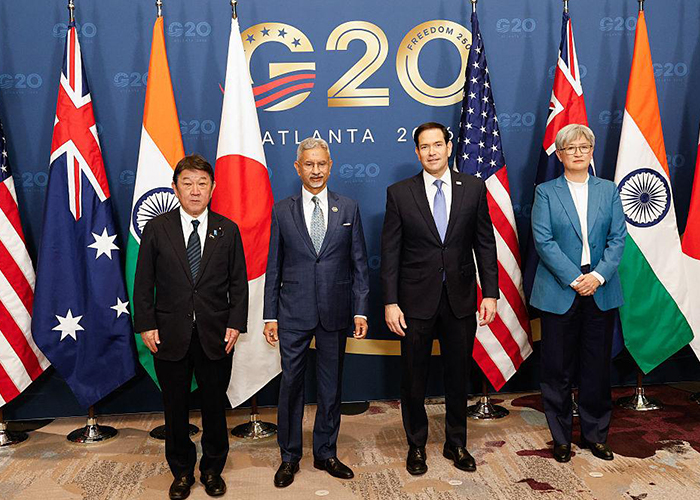
At their Atlanta meeting, Foreign Minister Penny Wong joined Rubio, Indian External Affairs Minister S. Jaishankar and Japanese Foreign Minister Toshimitsu Motegi to review progress across the partnership’s principal initiatives.
The ministers reaffirmed their commitment to a free and open Indo-Pacific and emphasised the importance of reliable supply chains, trusted infrastructure and economic security.
They also expressed concern about economic coercion, arbitrary export restrictions and market practices capable of disrupting critical industries.
The joint statement placed particular emphasis on strengthening cooperation in maritime security, digital connectivity, critical minerals, advanced communications and emerging technologies.
Maritime security remains one of the Quad’s most significant areas of practical cooperation.
In September and October, representatives from the four countries participated in the second Quad-at-Sea Ship Observer Mission, sailing aboard an Indian Coast Guard offshore patrol vessel from Chennai to Perth.
The mission, conducted from 25 September to 7 October, was designed to improve interoperability and operational cooperation among maritime security agencies.
The initiative builds on earlier activities intended to strengthen maritime domain awareness, information sharing and coordinated responses to unlawful maritime activities.
The Quad has also announced plans to conduct its first exercise under the Indo-Pacific Maritime Surveillance Collaboration initiative during Sea Dragon 2027.
The initiative is intended to improve the ability of participating countries to share maritime information and strengthen awareness of activities across the region.
A further Quad Maritime Domain Awareness symposium is scheduled for early 2027 under the Maritime Initiative for Training in the Indo-Pacific, known as MAITRI.
These developments reflect a shift towards operational cooperation, particularly in surveillance, maritime information sharing and the protection of sea lanes.
The Quad is also strengthening its engagement with Southeast Asian countries, recognising ASEAN’s central role in regional diplomacy and security cooperation.
At the July 2026 Foreign Ministers’ Meeting in Manila, the four countries reaffirmed their support for practical implementation of the ASEAN Outlook on the Indo-Pacific.
This included cooperation in maritime and transnational security, economic prosperity, critical technologies and humanitarian assistance.
The relationship is particularly significant as ASEAN members seek to maintain strategic autonomy while strengthening their capacity to respond to maritime disputes, economic pressure and emerging security challenges.
Economic security has emerged as another major priority.
The Quad ministers have identified critical minerals, energy security, semiconductor supply chains and infrastructure resilience as areas requiring closer cooperation.
At the Atlanta meeting, the partners welcomed a US commitment of US$10 million to support facilities in India and ASEAN countries that recover critical minerals from waste.
The initiative forms part of broader efforts to diversify supply chains and reduce vulnerabilities associated with concentrated production and processing capacity.
The Quad also convened its first Fuel Security Forum in September, examining ways to strengthen regional fuel security and strategic petroleum reserves.
For Australia, these initiatives intersect with national priorities involving critical minerals production, defence industry development, energy security and the resilience of international trade routes.
The partnership is also expanding its role in Pacific infrastructure.
Quad countries are working with Fiji on the modernisation of port facilities at Suva, Lautoka and Rokobili.
Australia is assessing the feasibility of a new transshipment port facility, while the United States is supporting the development of a strategic framework for Fiji’s ports.
The projects reflect the growing strategic importance of Pacific maritime infrastructure and the need for reliable transport and logistics networks.
The Quad has also supported secure digital connectivity initiatives, including undersea telecommunications cables and advanced communications networks.
The four governments have committed to developing trusted and resilient telecommunications infrastructure, with particular attention to 5G, 6G and Open Radio Access Network technologies.
The ministers have also agreed to identify potential semiconductor supply chain chokepoints before they cause significant disruption.
Cyber security cooperation remains a further priority, with Quad senior officials meeting in October to advance measures supporting a trusted and resilient regional digital environment.
The partnership’s growing focus on digital resilience reflects the strategic importance of telecommunications, cloud infrastructure, undersea cables and emerging technologies to national security and economic stability.
Humanitarian assistance and disaster response continue to provide another practical foundation for Quad cooperation.
The four countries have been developing an Indo-Pacific Logistics Network intended to improve coordination and the movement of personnel, equipment and supplies during major natural disasters.
Japan hosted the second logistics network tabletop exercise in September, with participants progressing standard operating procedures for future operations.
Australia, Japan and the United States are also scheduled to observe India’s annual joint humanitarian assistance and disaster relief exercise in November.
The initiatives are particularly relevant to Southeast Asia and the Pacific, where cyclones, earthquakes, tsunamis and other natural disasters regularly require multinational assistance.
The anticipated Manila leaders’ meeting also comes amid strengthening defence cooperation involving Australia, Japan, the Philippines and the United States.
On 28 October, the four countries’ defence ministers met in Cebu during the ASEAN Defence Ministers’ Meeting-Plus.
Australian Defence Minister Richard Marles joined his counterparts in committing to greater interoperability, expanded exercises and stronger regional defence cooperation.
The ministers announced plans to establish a Combined Coordination Centre in the Philippines, coordinate defence investments and increase the complexity and frequency of combined exercises.
They also expressed concern about developments in the East China Sea and South China Sea, opposing unilateral actions involving force or coercion that could undermine regional stability.
While the Cebu arrangement involves four countries, it is distinct from the Quad because the Philippines participates in place of India.
The convergence of these arrangements demonstrates the increasingly interconnected nature of regional security cooperation, with overlapping partnerships addressing maritime surveillance, defence preparedness, critical infrastructure and economic resilience.
However, the Quad’s future direction will depend partly on whether its members can maintain political momentum and translate announced initiatives into measurable outcomes.
The anticipated leaders’ meeting in Manila would provide an opportunity to reaffirm the partnership’s strategic priorities and assess progress on projects already under way.
It would also demonstrate continued high-level engagement at a time when questions have been raised about the Quad’s future following the absence of a leaders’ summit in 2025.
For Australia, the Quad remains an important mechanism for strengthening relationships with India, Japan and the United States while supporting wider cooperation with ASEAN and Pacific Island countries.
Its growing emphasis on maritime surveillance, resilient communications, critical minerals and humanitarian logistics also creates opportunities for Australian defence, technology, infrastructure and commercial space industries.
The outcome of the Manila meeting will be watched closely for any new commitments involving maritime security, critical technologies, economic security and regional infrastructure.
With strategic competition intensifying across the Indo-Pacific, the Quad’s significance will increasingly be measured not only through diplomatic statements, but through the practical capabilities, infrastructure projects and operational partnerships delivered by its members.