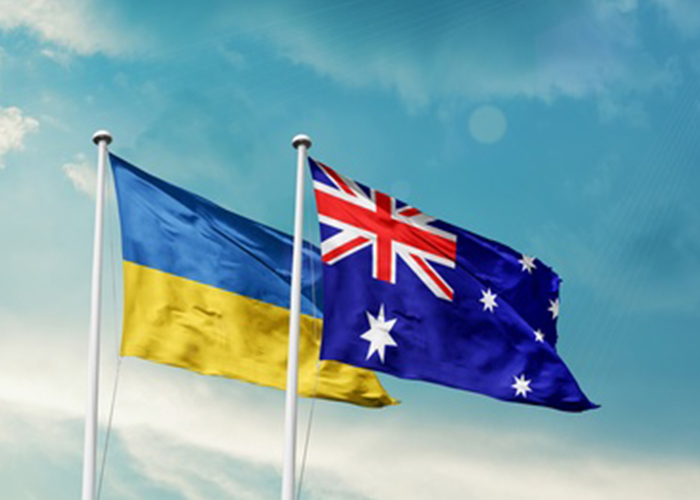
Australia and Ukraine have signed a 10-year bilateral security agreement that broadens the long-term relationship between the two countries, covering military assistance, defence industry cooperation, cyber security, intelligence, energy, reconstruction and investment.
Prime Minister Anthony Albanese and Ukrainian President Volodymyr Zelenskyy signed the Australia–Ukraine Bilateral Security Agreement in New York on 23 September, during meetings associated with the United Nations General Assembly. The agreement took effect upon signature and will remain in force for 10 years, with provision for an extension by mutual consent.
The agreement establishes a framework for Australian support extending beyond the current conflict, including assistance intended to strengthen Ukraine’s capacity to deter future aggression and contribute to its post-war recovery.
“This Bilateral Security Agreement underscores Australia’s ongoing commitment and enduring support for Ukraine as it defends itself against Russia’s aggression,” Albanese said.
“Australians stand with Ukraine.”
Speaking alongside Zelenskyy, Albanese said the agreement reflected Australia’s wider interest in maintaining international law and national sovereignty, arguing that the consequences of the conflict extend beyond Europe to the international security environment.
“This is an issue not just for Europe. This is an issue for the world,” Albanese said, adding that allowing a larger country to benefit from violating international law would establish a precedent with broader global consequences.
Under the agreement, Australia reaffirms its intention to provide “meaningful security assistance”, subject to Australian capacity, domestic law and other international obligations, to help Ukraine defend itself against the current invasion and deter possible future aggression. The document records that Australia had provided approximately $1.6 billion in military materiel and financial assistance to Ukraine’s security and defence forces by the date of signing.
A potentially significant element for the Australian defence sector is a commitment to explore deeper defence-industrial cooperation.
Australia and Ukraine will examine opportunities for joint production of air-defence systems, missiles, drones and other advanced products, including through joint ventures. The agreement also envisages cooperation on production, repair, maintenance and supply-chain projects involving uncrewed systems, maritime capabilities, air defence, missiles and other critical technologies. Some projects could potentially be undertaken in Ukraine.
The two countries will also continue military training, capacity building and exchanges of operational lessons. Australia has supported Ukrainian forces through Operation KUDU and will continue cooperation through NATO’s Security Assistance and Training for Ukraine framework.
Ukraine’s combat experience is explicitly identified as a potential source of knowledge for Australia. The Australian Government said Ukraine had developed “one of the world’s most innovative and agile fighting forces”, with its battle-tested expertise and defence sector offering lessons for Australian capability development.
The security relationship extends into intelligence and critical infrastructure. The two countries will consider greater intelligence cooperation and information sharing to detect and deter hostile state and non-state activity. Cooperation will also address terrorism, radicalisation, hybrid threats and threats to critical infrastructure.
Cyber security forms a dedicated part of the agreement. Australia and Ukraine intend to share information on cyber threats, vulnerabilities and incident-response methods and exchange expertise aimed at improving cyber resilience.
Australia will share experience associated with its 2023–2030 Australian Cyber Security Strategy, while Ukraine will provide lessons from countering cyber attacks during hybrid warfare and protecting information and communications systems under wartime conditions.
Energy security is another major component. Australia will continue considering practical assistance to Ukraine’s energy sector while expanding cooperation on nuclear safety and safeguards, renewable energy and energy-sector expertise.
The agreement also opens the possibility of cooperation in the peaceful supply of Australian uranium as Ukraine seeks to diversify the fuel cycle supporting its nuclear power plants. Australian expertise in large-scale solar, wind generation, geosciences, critical minerals and energy-system management is also identified as an area for potential collaboration.
Economic recovery and reconstruction feature prominently in the longer-term framework. Australia will seek to assist Ukraine in areas where it has relevant expertise and capacity, including development of capital markets, access to international financial institutions and insurance mechanisms, and attracting private investment for reconstruction.
Both countries will also seek to expand trade and encourage private capital for the restoration, reconstruction and modernisation of Ukrainian infrastructure and industry.
The agreement contains commitments concerning sanctions and legal accountability. Australia says it will continue imposing sanctions and trade restrictions while Russia’s aggression continues, work with international partners to counter sanctions circumvention, and maintain restrictions on sanctioned Russian sovereign assets within Australian jurisdiction while the conditions specified in the agreement remain in place.
Australia and Ukraine also reaffirm support for mechanisms addressing alleged war crimes and other international crimes. This includes engagement with the International Criminal Court, support for establishing the Special Tribunal for the Crime of Aggression against Ukraine and work towards international mechanisms intended to provide compensation for damage, loss and injury resulting from Russia’s aggression.
The signing was accompanied by an additional $60 million Australian assistance package comprising $45 million in Australian Defence Force equipment, $10 million for the Ukraine Energy Support Fund and $5 million in humanitarian assistance. The government said the package takes Australia’s overall contribution to Ukraine since Russia’s full-scale invasion to almost $1.9 billion.
Australia will also join the United Kingdom and Norway-led Maritime Capability Coalition for Ukraine, supporting development of Ukraine’s naval capabilities while providing Australia with access to operational lessons involving advanced maritime systems.
The government announced further sanctions alongside the agreement, saying the measures brought the number of Australian sanctions imposed on Russia and its supporters to almost 1,900, in addition to almost 300 listed shadow-fleet vessels.
Zelenskyy described the agreement as a long-term strategic document that would increase cooperation in security, trade and co-production, stressing that the relationship was intended to extend beyond the duration of the war.
Albanese similarly said he expected the partnership to continue into Ukraine’s eventual post-war development.
“I look forward to this agreement not just being in place during a period of war and conflict,” Albanese said, “but importantly as Ukraine is able to develop as a peaceful nation and to develop trade and the relations between our two countries as friends.”
Importantly, the agreement constitutes political commitments between Australia and Ukraine rather than a mutual-defence treaty. It states that its commitments remain subject to each country’s domestic and international legal obligations and Australia’s capacity, and are consistent with Australia’s status as a non-party to the armed conflict.
However, it establishes a mechanism for future crises. If current hostilities have formally ended and Russia subsequently launches another armed attack against Ukraine, Australia and Ukraine commit, at either country’s request, to consult within 24 hours on measures or support that could assist Ukraine in responding.