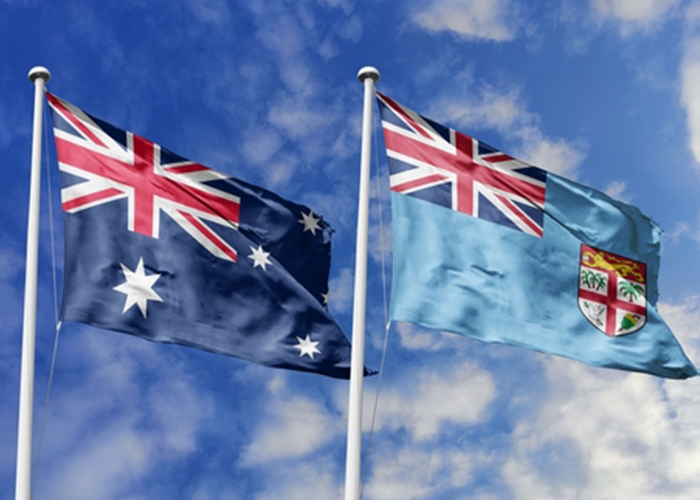
The signing of a landmark Australia–Fiji security agreement aimed at strengthening stability across the Pacific has been overshadowed by China’s test of a submarine-launched ballistic missile in the South Pacific, highlighting growing strategic competition across the Indo-Pacific.
Australia and Fiji signed the Ocean of Peace Alliance, also referred to as the Veitacini Treaty, in Suva, elevating bilateral security cooperation and establishing a framework that could eventually expand to include other Pacific nations. The agreement builds on Australia’s broader strategy of strengthening regional partnerships while supporting Pacific-led security initiatives.
Only hours after the treaty was signed, China’s People’s Liberation Army Navy launched a long-range ballistic missile carrying a simulated warhead from a nuclear-powered submarine into the South Pacific. Beijing described the launch as part of its routine annual military training programme and said it complied with international law and was “not directed against any specific country or target.”
The timing immediately drew attention throughout the region, with Australia, New Zealand and Japan expressing concern over what they described as another demonstration of China’s expanding military capability and strategic reach.
Australian Prime Minister Anthony Albanese described the Australia–Fiji agreement as an important investment in a secure, stable and resilient Pacific, saying the treaty reflects the shared commitment of both nations to regional peace and cooperation. The agreement establishes closer consultation on security matters while reinforcing Pacific sovereignty and regional partnerships.
Foreign Minister Penny Wong said the missile launch was regarded by Australia as “destabilising to the region” and emphasised that such actions reinforce the importance of Pacific nations working together.
“We have been clear with China that we regard the test firing as destabilising to the region,” Senator Wong said, adding that the launch “underscores the need for countries of the region to work together.”
Deputy Prime Minister and Defence Minister Richard Marles confirmed Australia had lodged formal diplomatic protests with China both in Canberra and Beijing.
Marles said Australia’s concern centred not simply on the timing of the launch but on the broader strategic implications of China’s expanding long-range missile capability, particularly its sea-based nuclear deterrent.
China, however, rejected suggestions that the launch was politically motivated.
According to China’s official Xinhua News Agency, the Ministry of National Defense stated the missile test was:
“A routine part of China’s annual military programme” that “complied with international law and international practice and was not directed against any country or target.”
The launch is believed to have involved one of China’s latest submarine-launched ballistic missile systems, demonstrating the growing maturity of the People’s Liberation Army Navy’s sea-based nuclear deterrent. Defence analysts have noted that China’s expanding submarine capability represents an increasingly significant element of its strategic posture in the Indo-Pacific.
For Australia, the juxtaposition of the two events underscores the increasingly complex security environment confronting Pacific nations.
The Ocean of Peace Alliance is intended to deepen cooperation across defence, maritime security, humanitarian assistance, disaster response, infrastructure resilience and broader regional stability. Rather than being directed at any single country, Australian officials have consistently described the agreement as supporting Pacific-led security and sovereignty.
Nevertheless, the coincidence of China’s missile launch on the day of the treaty signing has reinforced concerns about strategic competition in the Pacific, where Australia, China and other major powers continue to compete for influence through diplomacy, infrastructure investment and security partnerships.
For the defence and security community, the events highlight the growing importance of maritime domain awareness, long-range surveillance, integrated missile warning, critical infrastructure resilience and closer regional security cooperation as the Indo-Pacific continues to emerge as one of the world’s most strategically contested regions.